

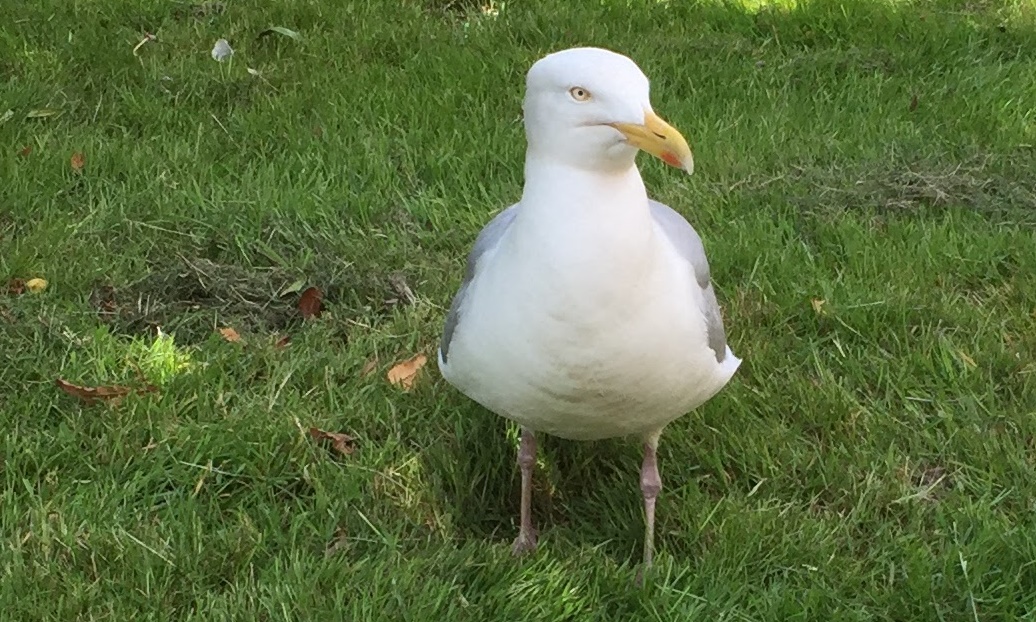

Years ago, a friend told me the story of the time a seagull crapped in her mouth. She was on a date at the time. I can’t remember if it was a first date, but it was certainly an early one. The two were strolling along, and she looked up at the man next to her, who was a good bit taller. It was just as she opened her mouth to respond to something he’d said that the beast attacked. She said it tasted the same way that a bin smells.
Vicarious trauma is a concept that seems to have gained a good deal of ground in society recently, and it won’t surprise you to know that, even years later, her story comes to mind every single time I see a seagull. And I live on the coast. I see it in their eyes, sometimes. They have the same eerie sense of inscrutability as a shark. I see them wondering about trying for me next. In all honesty, I don’t expect that will ever change.
And so, as you can imagine, the sight of a seagull arriving on the pitch during Dundee United’s Europa Conference League home leg against UNA Strassen, then refusing to leave, represented something of a distraction. It even made it on to the BBC’s live blog – a sentence that, regardless of context, almost always means something shameful or bewildering has occurred.
Crowd captivated
The bird in question arrived at some point during the first half – landing somewhere in the space behind our leftback. It was an adolescent, and although I am unsure what brought it there, it was certainly in no rush to leave – spending the vast majority of the game swooping around the players, often at head height, rushing through play as it struggled to gain the elevation needed to get out the stadium.
The longer it stayed, the more the interest spread. Play continued uninterrupted, but after a few minutes, most of Tannadice was fixated. As United pressed the Luxemburgers into their box, in front of the East Stand the bird made a path for the vacated space at the other end. Anticipation grew in the crowd.
‘Oooooohhhhhhhhhhhhhh!!’ came the cheer, with noise growing in volume and intensity as it approached. Then it landed. Elation broke.
“SeaGULL! Sea-GULL!! Sea-GULL!!!”, the fans chanted.
This went on for quite some time. As it continued, I wondered if anyone would act. Would a keeper try to grab it? Would Jim Goodwin? The United manager certainly has the air of a man who could catch a seagull.
In fact, former Scottish Conservative leader Douglas Ross actually held a parliamentary debate calling for tougher action on seagulls recently. Given his experience, as well as his role as an assistant referee, I found myself wondering if he would emerge to rid the game of the beast. But would the party’s calls for a nationwide ‘seagull summit’ help with this sort of problem?
Summit’s up
Watching from the sidelines, it was hard to see how convening every seagull in Scotland for talks would help the situation, but then I’ve never been an MSP, or indeed held a seagull summit.
As I rued the reliability of political promises, an old quote from Pep Guardiola came to mind: “When you watch the game you don’t see Busquets, when you watch Busquets, you see the game.” But what was I trying to understand, watching this bird, rather than the game?
I asked my dad, standing next to me, what he made of it. He seemed genuinely impressed with its movement, and he was a United fan during the days of Paul Sturrock. It was certainly covering every blade of grass – as the cliché goes – generally sticking to the base of midfield, and using its agility and clever movement to avoid collision.
New loanee Isaac Pappoe, playing in centre midfield, particularly struggled to find space away from the bird. And so on and on it went – with the bird moving, the fans roaring in anticipation, and the celebrations following every time it landed.
United began to pin Strassen back, asserting more dominance as they settled into the unfamiliarity of European football – as well as the fact wholesale squad change meant most of them had only met each other very recently. In fact, the whole thing had an odd, dreamlike quality to it. A real game taking place in July. A 7.45pm kick-off on a Thursday. Opposition from a town without a Greggs.
For much of the stadium – basically anyone under the age of 35 – this was an entirely new experience. We’d waited years for it, and, given the standard of the other teams waiting in later rounds, it was extremely unlikely the experience would last for long. Yet rather than savour it, all anyone could focus on was the seagull – bravely trying to find an updraft, or enough strength in its wings, to escape the cavernous bowl all around.
In the end, it took the opening goal to make me forget about the bird. The seagull had been harrying the centre mids, while a loose pass from the Strassen defence was snaffled. Zac Sapsford megged a rushing defender with an elegant spin, before calmly stroking the ball into the smallest pocket of the corner from a genuinely implausible distance.
And then it was gone
The crowd, inevitably, went nuts. Both the goal and the moment were truly quite beautiful, and to see it in a packed stadium felt good. Years of thwarted dreams have taught me never to be too optimistic when it comes to United – never to let myself believe too much – even when it feels like we are winning. After all, whether it is a question of romance or football, experience shows that the taste of happiness can turn bitter all too quickly.
And yet my friend – the one who had the seagull crap in her mouth – has no fear of seagulls. She dealt with the experience and moved on – in fact that early date led to others. It was over a decade ago, and they’re married now. And in that sense, our disappointments need not define us. The past is not our future, and the prospect of United soon being kicked out of Europe isn’t an argument against engaging with current joy. If anything, it’s quite the opposite.
So why worry about the next leg? Why worry about the next date? Why not focus on the here and now and try to enjoy our success for as long as it lingers in the air?
The crowd boiled in celebration. Lost in the delirium, I forgot about the seagull entirely. It was only at the end that I realised I hadn’t notice it leave. At the final whistle I cheered, but still, I kept one hand placed carefully over my mouth.